 AI for ADHD
The Next Visible Step Rule
Clarity lives at the edge of action.
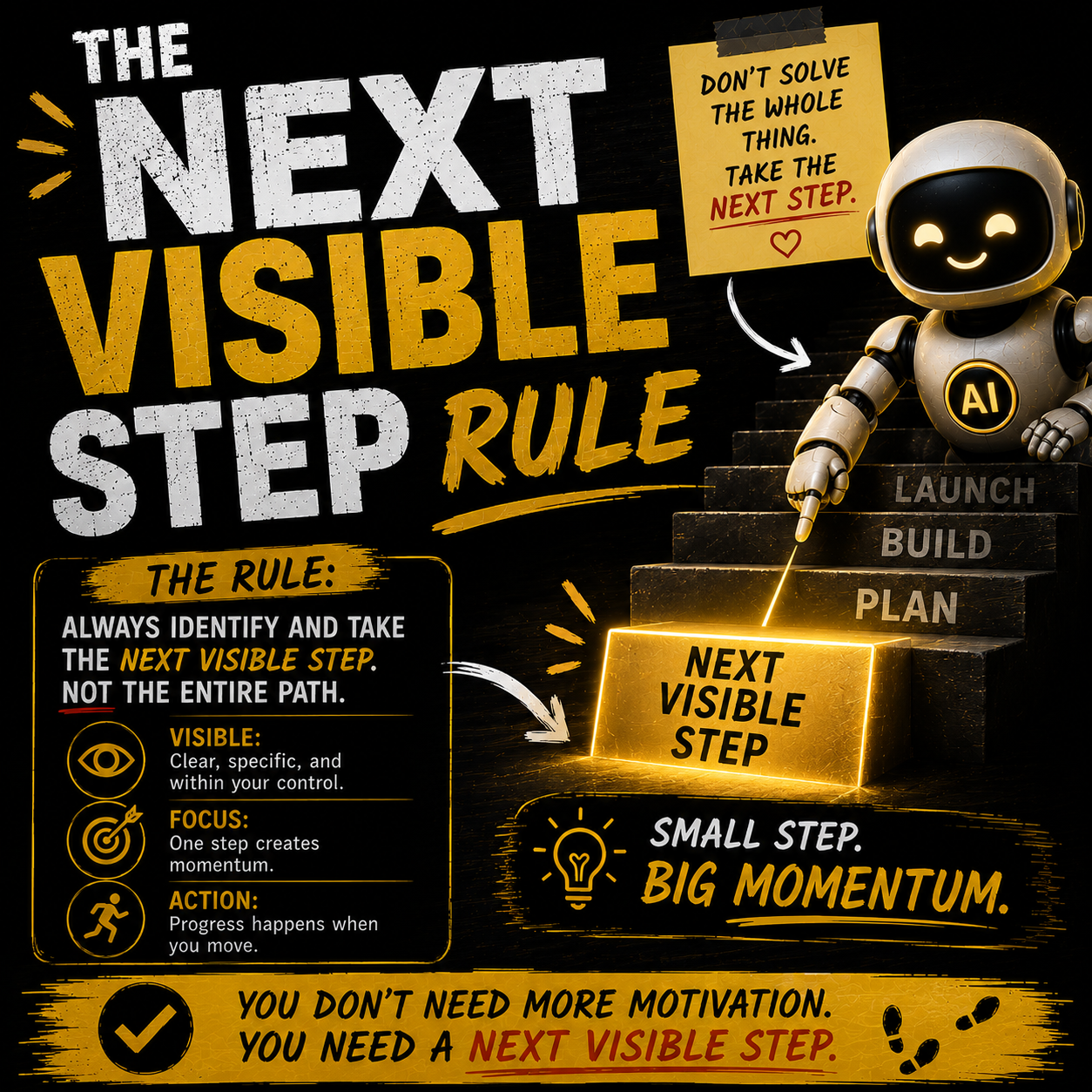
Day 06: The Next Visible Step Rule
Subject: If the task feels foggy, it is too large. Clarity lives at the edge of action.
Opening Reset
“Work on project” sounds responsible until you try to do it. Then it turns into fog. Where do you start? Which file? Which decision? What does “work on” even mean? The task sits there, looking adult and reasonable, while your nervous system quietly refuses to move. This is not always procrastination. Sometimes it is bad task design.
Before we do anything heroic, let us make one small agreement: the goal of this reset is not to become a different kind of person by dinner. The goal is to create a kinder interface between your real brain and your real life. MrTC Builds is not here to hand you a louder productivity personality. It is here to help you build an external brain that can catch what you drop, show you the next honest step, and let you return without performing a public apology tour for being human.
This is especially important if your attention, energy, or executive function changes from day to day. A tool that only works when you are already regulated is not a reset tool. It is a fair-weather friend with pretty stationery. Today’s practice is designed for the moment when the thread is slipping, the list is too loud, or the task is shaped like fog.
Tiny Lesson
The Next Visible Step Rule says: rewrite the task until the first physical or digital action is obvious. Open the document. Find the invoice. Rename the folder. Draft three bullets. Send one question. Put the shoes by the door. A visible step is something your body can picture doing. It is not a category, identity, aspiration, or vague improvement campaign.
There is a quieter skill underneath today’s practice: separating the work from the emotional weather around the work. A task can be real without being an emergency. A worry can be loud without being a command. A missed step can need repair without becoming proof that you are fundamentally unreliable. This separation is not soft. It is strategic. When everything is fused together — task, shame, memory, fear, identity — even simple actions start to feel heavy.
MrTC Builds systems are built around containment before control. First we give the thought, task, or decision a place to land. Then we decide what it means. Then, only if needed, we choose an action. That order matters. Many people try to start with control: make the perfect plan, fix the whole system, become consistent forever. But the overwhelmed brain usually needs containment first. It needs to see the pieces outside itself before it can choose well.
This is why the best reset tools are often visually humble. One page. One prompt. One ritual. One small review. They work because they reduce the number of invisible jobs your brain is doing at once.
Why This Works
Task initiation depends on clarity. ADHD and stressed brains often have trouble crossing the gap between intention and first movement when a task contains hidden decisions. “Prepare presentation” may actually include finding the deck, deciding the audience, reviewing notes, choosing a story, making slides, and emailing a question. No wonder the brain stalls. Splitting the task reduces working-memory load and creates a smaller action threshold.
Think of attention as a limited working surface, not an infinite warehouse. When the surface is covered with loose notes, open loops, and emotional static, there is less room for the actual task. You may still care. You may still be capable. You may even have plenty of skill. But the available surface is cluttered, so starting feels harder than it “should.” That word — should — is usually a sign that the system is asking for shame instead of design.
A better design reduces the number of decisions required to begin. It creates a visible cue, a small action, and a clear stopping point. It also respects re-entry. Deep, meaningful work often needs focus, but focus is not summoned by yelling at yourself. It is invited by rituals, boundaries, and fewer unnecessary choices. When a system lowers the cost of coming back, you do not need to spend half your energy proving that you deserve to start again.
There is also an identity shift here. You are not the problem being solved. You are the person the system serves. That is a premium standard: the reader as the hero, the tool as the guide, the next step as the invitation.
A Real-Life Reset Example
Nina has “update website” on her list for three weeks. Every time she sees it, she feels a tiny internal collapse. When she splits it, she discovers the real first step is not updating anything. It is opening the homepage and writing down three sections that feel outdated. That takes seven minutes. After that, the next step is clearer: ask AI to draft replacement copy for one section using her notes. The project did not get smaller. The entry point did.
Notice what changed in that example. Not the whole life. Not the entire personality. The change was a better transition. The moment stopped being “I must fix everything” and became “I can locate the next honest move.” That is the heart of sustainable momentum.
Small transitions are easy to underestimate because they do not look dramatic from the outside. Nobody claps when you rename the file, paste the context, park the idea, or choose the first ten-minute action. But these are the moves that keep a system alive. They are the hinges. Without hinges, even a beautiful door is just a large rectangle leaning against a wall.
If you are building an external brain, pay attention to these hinge moments. Where do you usually freeze? Where do you lose the thread? Where does a tool create more pressure than relief? Those are not character defects. Those are design notes.
Using AI as an External Brain
AI can act as a microtask splitter when it is given strict boundaries. Try: “Here is the task I am avoiding: ___. Ask me up to three clarifying questions if needed. Then break it into next visible actions. Each action must begin with a verb and take less than ten minutes to start. Do not give me a full productivity plan.” This keeps the assistant focused on initiation rather than performance theater.
The best use of AI in the Daily Reset is not to outsource your agency. It is to support it. You remain the person with taste, values, context, and final choice. The assistant can hold categories, sequence steps, summarize a messy page, or ask a clarifying question when your working memory is crowded. That is very different from letting it prescribe a generic life plan for a pretend person with unlimited energy.
A helpful AI reset prompt usually includes three boundaries:
- Scope: “Do not plan my whole week. Help with this one reset.”
- Tone: “Use a calm, practical, low-shame tone.”
- Output: “End with one next visible step.”
Those boundaries protect you from the most common AI failure mode: overproduction. A giant answer can feel impressive and still be unusable. In a reset moment, usefulness beats impressiveness. Relief beats volume. One clear next action beats a majestic spreadsheet you will never open again.
The Common Trap
The common trap is believing small steps are childish. They are not. Small steps are how complex work becomes executable. Deep work often requires long focus, but getting into deep work requires a clean threshold. A pianist still places one finger on one key. A writer still opens one file. A founder still sends one message. The size of the mission does not remove the need for a visible first move.
Another trap is trying to earn support by making the system perfect first. You do not need a perfect template to begin. You do not need matching icons, a fully migrated database, or a Sunday planning ritual that looks like it was photographed for a lifestyle brand. You need a place to put the thing, a way to see it again, and a small next move that does not require a personality transplant.
If the tool becomes a stage where you perform being organized, simplify it. If the prompt produces too much, narrow it. If the review makes you feel judged, change the question. Ethical habit design is not about trapping yourself into productivity. It is about making the supportive action easier to take and the shame spiral harder to enter.
A good reset system should feel like a calm guide saying, “Here is where we are. Here is what matters. Here is the next door.” Not, “Here is a complete record of every way you have failed to optimize your human existence.” We decline that newsletter, thank you.
Make It a Repeatable System
One useful practice is helpful. A repeatable practice is a system. The difference is not complexity; it is where the practice lives, when it is triggered, and how easy it is to reuse when you are not at your best. If today’s reset only exists as a good idea in your head, it will probably disappear right when you need it. Give it a home. Put the page in one obvious place. Save the prompt where you already open AI. Write the ritual on a sticky note, a note app, or the first page of your planner. The location is part of the support.
Then choose a trigger that is kind, not punitive. A trigger might be “when I feel the tab tornado,” “after lunch,” “before I ask AI for a plan,” “when I reopen the laptop,” or “when I notice I am rereading the same task without starting.” We are not trying to engineer a trap. We are creating a small bell that says, “This is a reset moment.” The cue should feel like an invitation back to yourself, not an alarm announcing that you have failed.
Finally, add a tiny reward that reinforces relief. Cross off the first visible step. Close one loop. Say “re-entry complete.” Put a check mark next to the reset, not because you earned a gold star from the productivity police, but because your brain benefits from seeing that return is possible. Small wins teach the nervous system that effort can end in relief, not just more demands.
If you share this practice with a client, teammate, partner, or community, keep the same principle: build with people, not for them. Ask what part feels heavy. Ask what would make the first step easier. The person using the system is the hero; the system is only the guide.
Try This Today
Pick one avoided item and interrogate it gently. Is it actually a project? Is it actually a decision? Is it actually a fear? Then rewrite it three times, smaller each time. “Work on taxes” becomes “find tax folder.” “Find tax folder” becomes “open file cabinet.” “Open file cabinet” becomes “stand up and walk to cabinet.” Start there.
If you have more capacity, add a second pass:
- What is the smallest version of this practice that would still help on a bad day?
- Where should this live so you can find it when your brain is noisy?
- What sentence could you give AI so it supports the practice without expanding it into a project?
Reflection Prompt
Which task on your list would become less frightening if it were rewritten as a physical first action?
Forget the whole staircase. Your only job right now is to see the next step clearly enough to take it. If your system can do that—make one action visible when everything else is foggy—it is doing exactly what it should.
This is Day 06 of The Daily Reset: 30 Days to a Calmer External Brain.